


Uncategorized
Young People Already Know What Democracy Should Look Like. Are We Listening?
15 June 2026


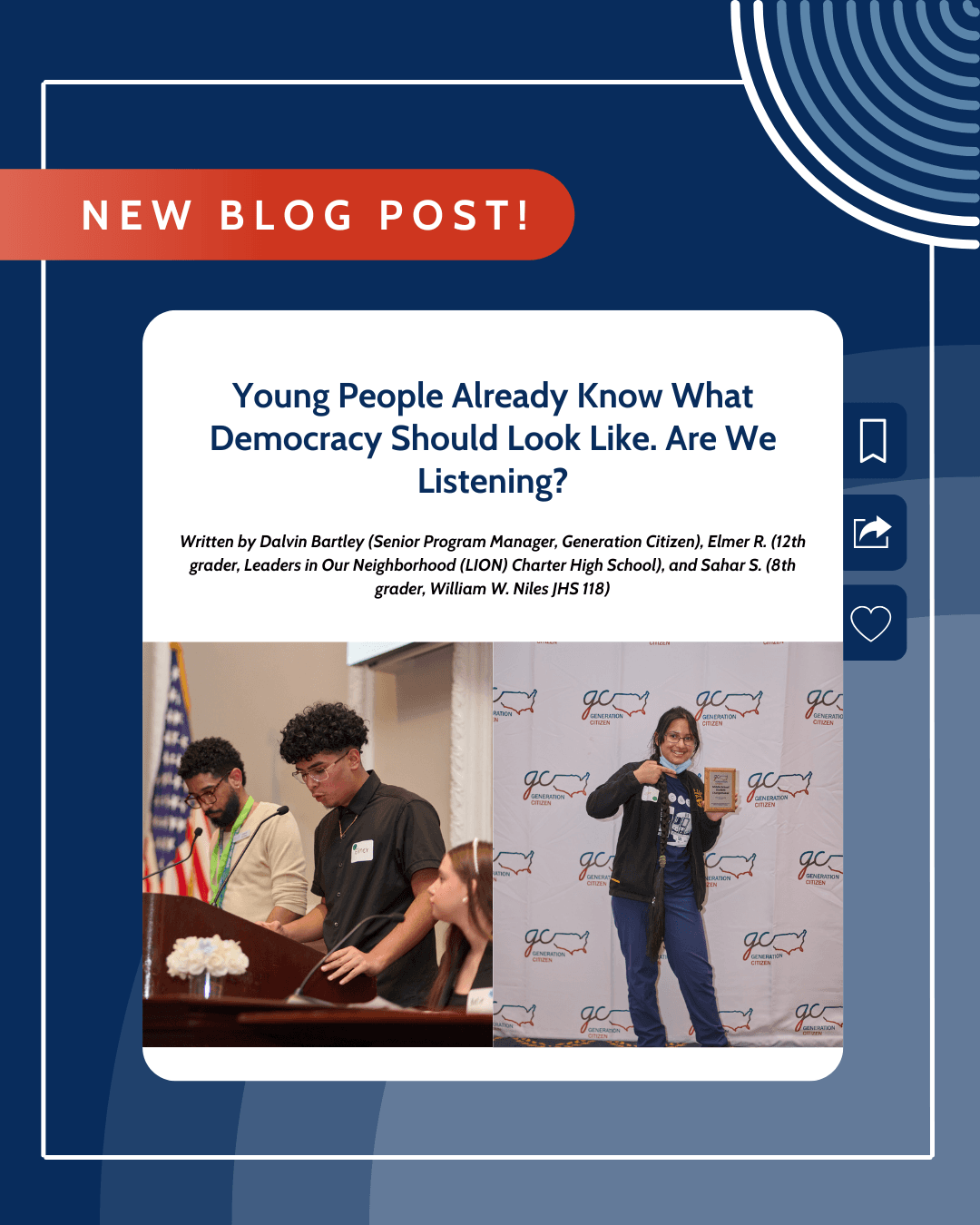
Written by Dalvin Bartley (Senior Program Manager, Generation Citizen), Elmer R. (12th grader, Leaders in Our Neighborhood (LION) Charter High School), and Sahar S. (8th grader, William W. Niles JHS 118)
We’re living through a civic moment defined by uncertainty, polarization, and decisions that will shape young people’s futures long after today’s headlines fade. Yet, the systems they’re inheriting were never designed with them in mind. When students are given space to imagine the future of democracy, they offer clarity and possibilities that adults often miss. That’s the promise of Future250: a place where young people lead the visioning we urgently need and where our role is to listen.
Future250, Generation Citizen’s youth‑led civic visioning initiative, invites students to imagine what democracy should look like 25, 50, and even 250 years from now, and to ground that vision in their lived experience. Young people are often described as disengaged, but what we see across the Bronx tells a different story. Students are not apathetic. They are often simply not invited into the conversations that shape their lives. When they are given real space to imagine the future of their communities and our democracy, they name truths and possibilities that adults routinely overlook. It is not only about identifying issues. It is about cultivating vision, agency, and a sense of belonging in civic life.
In classrooms and roundtables across the region, students are redefining what leadership looks like. They’re connecting personal experience to systemic change and beginning to see themselves as contributors to the future, not just observers of it. Their insights show us that youth civic visioning is essential to building a democracy that reflects the people who will inherit it. Elmer, a 12th grader at LION Charter High School, has seen firsthand how Future250 creates space for students to lead and shape the civic conversations that matter most to them:
“Future250 has meant more to me than I ever expected. As a senior, it showed me that young people can advocate for themselves when we’re given the chance and the support to do it. Most of the time, the biggest barrier isn’t ability but the voice in your head telling you that you can’t make a difference. Through Future250, I learned that even a small effort can stand out. I never imagined I would be speaking about food insecurity, a real issue in my community, in front of a large audience, or that I would win a diversity and collaboration award for that work. That moment taught me that when you believe in something and try to make change, it can spark something bigger. Moderating the Youth Roundtable deepened that lesson. What stood out to me was how passionate and prepared my peers were. Every student knew exactly what they were advocating for, and you could hear the purpose in their voices. It reminded me that young people are brilliant, thoughtful, and ready to lead when adults give us the space and support to show it. My vision for the future of democracy is one where communities, schools, and elected leaders work together—sharing ideas, building real connections, and strengthening advocacy for the next generation. If we do that, our voices won’t just be heard; they’ll help shape the future.”
Sahar, an 8th grader at William W. Niles JHS 118, brings a powerful middle school perspective on what it means for young people to imagine the future of democracy and be trusted to guide it:
“Moderating the virtual roundtable was something I was nervous about at first. I kept wondering if I had enough experience or if I even belonged in that role. But once the conversation started, everything changed. The students who joined were just like me. They cared about their communities, paid attention to what was happening around them, and wanted to make a difference. That helped me realize that moderating was not about being perfect. It was about helping everyone feel comfortable sharing their ideas. One thing I notice in my school and community is that young people see a lot that adults sometimes miss. We notice when things feel unfair or when our voices are pushed aside. Adults often think we are too young to understand what is going on, but we care deeply about the issues that affect us. Democracy shapes our lives too, and we deserve to be part of the conversation. A moment that stayed with me was when a student said they wished adults would really listen, not just hear us. That made me think about how powerful it is when young people are trusted to speak for themselves. When students are given space to imagine the future, they come up with ideas that are creative, honest, and full of hope. My vision for the future of democracy is one where young people are included, respected, and seen as leaders right now, not just someday.”
Elmer and Sahar remind us what becomes possible when young people are trusted to lead. Their reflections echo what we see across classrooms every day. Students want agency, belonging, and a real say in shaping the world they are growing up in. They are not waiting to become leaders someday. They are already paying attention, already naming what is working and what is not, and already imagining what our democracy could look like if their ideas were taken seriously.
Adults often underestimate how ready young people are to guide civic conversations, but Future250 shows the opposite. When students are given space, structure, and support, they bring clarity, creativity, and a sense of purpose that many civic spaces are missing. Future250 is not a one‑off event. It is a model for what civic learning can be when youth voice is centered rather than sidelined.
The stories Elmer and Sahar shared make one thing clear. Adults, schools, and communities must create more spaces like Future250 where young people can shape the conversations that shape their lives. Students are already imagining the future with honesty and courage. Our job is to follow their lead. Educators, policymakers, and community members must listen, invest, and make room for youth vision. A stronger democracy begins with believing in young people’s power right now.